Wednesday, January 5, 2011
Khao Sam Roi Yot
First morning of birding 2011 today, with an early morning trip to Khao Sam Roi Yot National Park. I was looking for Manchurian Reed Warbler but only managed ORIENTAL and BLACK-BROWED Reed Warbs, as well as a few Think-bills. The trip got year listing underway (my very modest 2010 total was 445 across Asia, the UK, and USA). Highlights this morning included EASTERN MARSH HARRIER, PIED KINGFISHER, LONG-TOED and TEMMINCK'S STINTS, PURPLE HERON, YELLOW BITTERN and INDOCHINESE BUSHLARK.

Friday, December 31, 2010
A big bird to end the year
I took a young Australian birder out for the day yesterday (30th). As it was his first day birding in SE Asia he managed to get more than 60 ticks! The quality was pretty high, ending the day with a vagrant CINEREOUS VULTURE at the raptor watchpoint to the west of Petchaburi. This excellent area also produced GREATER SPOTTED EAGLE, OSPREY, at least ten BLACK KITES, BLACK-SHOULDERED KITE, BRAHMINY KITE and two EASTERN MARSH HARRIERS. Other birders have also seen Steppe and Imperial Eagles in this area in recent days. I have marked the location of the viewing area on this GoogleMap.


Earlier in the day we visited Pak Thale, which gave us an excellent selection of waders including 1-2 SPOON-BILLED SANDPIPERS, 15 NORDMANN'S GREENSHANK, and perhaps a thousand GREAT KNOT. We also picked up a rather smart adult winter PALLAS'S GULL.


Cinereous Vulture dwarfing a lineatus Black Kite


Earlier in the day we visited Pak Thale, which gave us an excellent selection of waders including 1-2 SPOON-BILLED SANDPIPERS, 15 NORDMANN'S GREENSHANK, and perhaps a thousand GREAT KNOT. We also picked up a rather smart adult winter PALLAS'S GULL.

Pallas's & Brown-headed Gulls

Long-toed Stint

Pacific Goldie

Broad-bill

Stiltastic
Tuesday, December 21, 2010
Knot a lot!
Pak Thale/Lae Pak Bia area again today - very productive with one SPOON-BILLED SANDPIPER, a flock of 45 NORDMANN'S GREENSHANK, and two Thailand ticks for me in the form of three RED-NECKED PHALAROPES and five PIED AVOCET (both quite rare in Thailand).
Also the largest number of GREAT KNOT I have ever seen, with a single flock estimated at 600-800 birds.


Also the largest number of GREAT KNOT I have ever seen, with a single flock estimated at 600-800 birds.

A large flock of waders, predominantly Great Knot,
but with Nordmann's taking the front row.

BirdLife International estimates the population of adult Nordmann's
at 500-1,000 - so a flock of 45 birds is rather significant!


Sunrise Spooner
Friday, December 10, 2010
Black-faced Spoonbill'd Sandpipers
Just back from a long, tiring but rewarding day at Pak Thale, which produced a BLACK-FACED SPOONBILL (a rare straggler here) 3 SPOON-BILLED SANDPIPERS, as well as 5 NORDMANN'S GREENSHANKS. I also got an uninspiring tick in the form of at least three HEUGLIN'S GULLS.


The only thing better than a Spoon-billed Sandpiper is...

...two Spoon-billed Sandpipers
 That's a lot of Marsh Sandpipers
 Brahminy Kite
 Open-billed Storks
 Male and female Malaysian Plovers, Laem Pak Bia
 a nice comparison between Malaysian and Kentish Plovers


Wednesday, November 17, 2010

Paddyfield Pipit
A wander around Mae Sot Reservoir this morning produced a nice selection of birds including five or six CHESTNUT-TAILED STARLINGS which I don't get to see too often, plus a selection of typical wintering warblers including at least four THICK-BILLED WARBLERS and two DUSKY WARBLERS, as well as three BROWN SHRIKES and several PADDYFIELD PIPITS.

Brown Shrike
Tuesday, November 16, 2010
Cyornis headache
I'm in Mae Sot this week, working each day but sneaking in a bit of birding at the reservoir before work. A nice selection of birds today included BLUE MAGPIE, four PURPLE SUNBIRDS, several PIED BUSHCHATS, one or two RADDE'S WARBLER and this tricky female Cyornis flycatcher...


This flycatcher twice gave a sharp, almost scolding "tak" call, which (according to Robson 2004) reduces the options to either Blue-throated, or Hill Blue Flycatcher. Given the bird's rather greyish lores and relatively pale, non-uniform breast with orange restricted to the breast (not extending onto the flanks), I think this bird is a female BLUE-THROATED FLYCATCHER. However the top photo shows no evidence of a "strongly refescent" tail, which is noted as a feature by Robson. This may be simply because the photo was taken in deep shade and the tail is out of focus, or possibly because this bird is of the race glaucicomans (split by some authorities as "Chinese Blue Flycatcher") though I'm struggling to reconcile the other features of that race (strongly orange breast with contrasting pale throat, brown-washed flanks - see this image) with the subject bird. I've seen females of both Hill Blue and Blue-throated before, but not recently, so thoughts/suggestions/confirmation welcome!
EDIT, 3rd Oct 2011: After seeing another migrant Cyronis at Suan Rot Fai I feel more comfortable with the idea of the mae Sot bird being Chinese Blue, most notably because of the pale throat. I believe the bird linked to in the post above, seen by another observer in Suan Rot Fai in Sept 2008, is actually a Hill Blue, rather than a Chinese Blue Flycatcher (due to the lack of contrast between breast and throat).
Wednesday, November 10, 2010
Get your Rocks off....
Productive morning on the patch, with some different (but expected) migrants/winter visitors showing up. The best being a THICK-BILLED WARBLER and a BLACK-NAPED MONARCH.
I had given pride of place to a male WHITE-THROATED ROCK THRUSH that I discovered feeding in a secluded shelter belt, however upon returning home I looked at the record shots that I had taken of the bird and I am rather devastated to see that it appears to have a damaged right leg and foot.

I had given pride of place to a male WHITE-THROATED ROCK THRUSH that I discovered feeding in a secluded shelter belt, however upon returning home I looked at the record shots that I had taken of the bird and I am rather devastated to see that it appears to have a damaged right leg and foot.

Crippling...
The fact that this stunning bird is seriously injured is very upsetting. It also throws significant doubt on the origin of the other two WTRT that I found in the park last year. At that time I considered the risk of captive origin, but I had no evidence so gave the birds the "benefit of the doubt". However I now see no alternative but to remove this species from the patch list. I just hope that this particular individual is able to survive. I often think about visiting Chatuckak weekend market to see what birds are being sold, but it is such a depressing experience that I have avoided doing so for a long time. However, given this situation I will probably pay a visit in the near future.
Other padders seen this morning included 1-2 ARCTIC WARBLERS 8+ TAIGA FLYS, 5+ BLACK-NAPED ORIOLES, 3+ BLACK-CAPPED KINGFISHERS, 30+ BARN SWALLOWS and 6 PADDYFIELD PIPITS.


EDIT: Phil Round has commented as follows...
"I don't think we have seen White-throated Rock Thrush in trade and on balance, notwithstanding your bird with damaged foot, I would guess these are genuine migrants. In the absence of evidence to the contrary, I would count them [as wild]....the timing is spot-on for migrants. We have also seen females at other sites around Bangkok."
Other padders seen this morning included 1-2 ARCTIC WARBLERS 8+ TAIGA FLYS, 5+ BLACK-NAPED ORIOLES, 3+ BLACK-CAPPED KINGFISHERS, 30+ BARN SWALLOWS and 6 PADDYFIELD PIPITS.
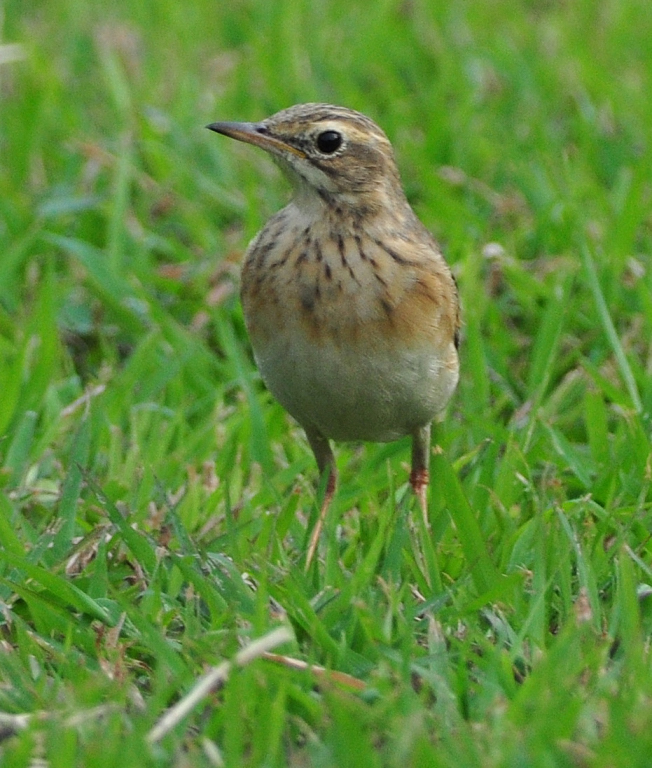

Paddyfield Pipit
EDIT: Phil Round has commented as follows...
"I don't think we have seen White-throated Rock Thrush in trade and on balance, notwithstanding your bird with damaged foot, I would guess these are genuine migrants. In the absence of evidence to the contrary, I would count them [as wild]....the timing is spot-on for migrants. We have also seen females at other sites around Bangkok."
Subscribe to:
Posts (Atom)